
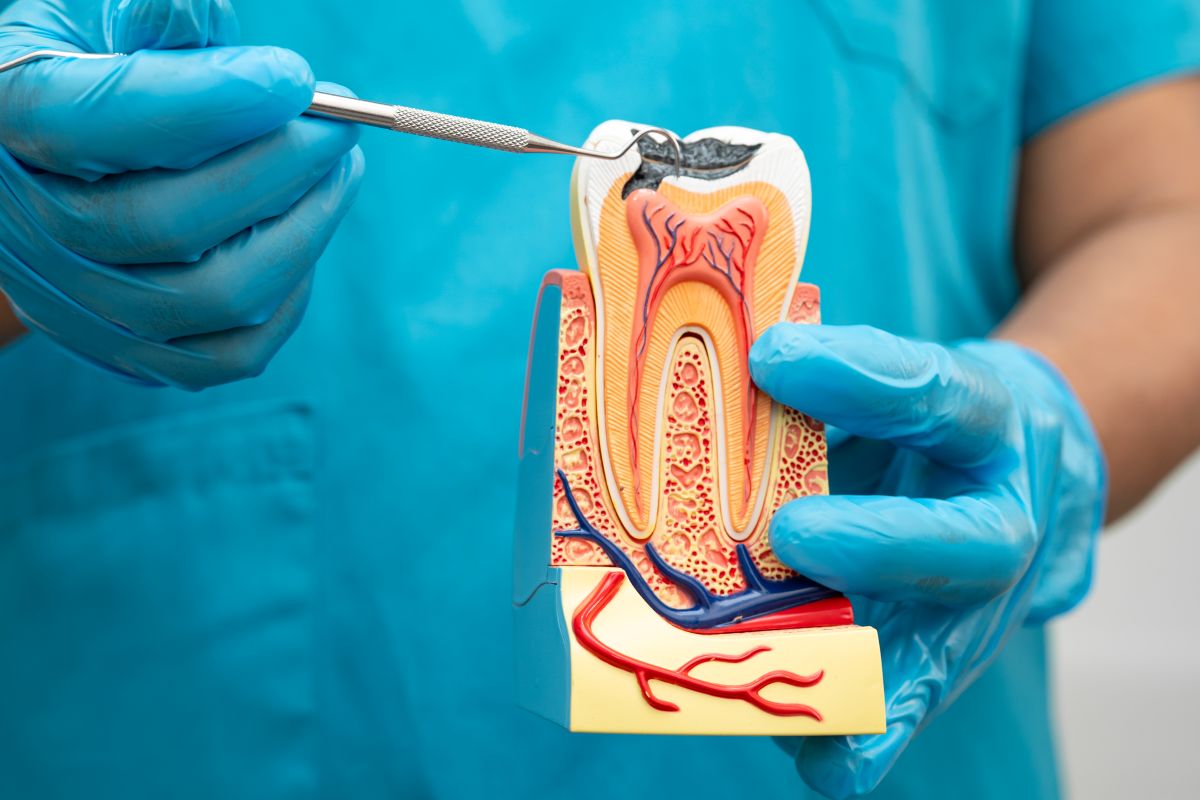
Most people picture a cavity as a dark hole, something you’d only notice once it’s already a problem. In reality, tooth decay starts long before that, and a surprising number of cavities never become visible at all. Knowing what to look for, and what you can’t see without help, can be the difference between a little support for your body’s natural ability to heal and a filling.
At Bruno Integrative Dentistry, we look at every cavity through a biologic dentistry lens: not just what’s visible on the tooth, but what it’s telling us about the whole body. Here’s what a cavity actually looks like at each stage, how to spot the signs that don’t show up in the mirror, and what it means for your care.
Stage 1: The White Spot (Demineralization)
The earliest visible sign of decay isn’t a hole at all, it’s a chalky white spot on the enamel. This is demineralization: the tooth is losing calcium and phosphate faster than saliva and diet can replace them. The structure is still intact at this point, which is exactly why it matters. A white spot is your body signaling an imbalance, not yet damage.
This is also the stage where a biologic, root-cause approach has the most to offer. Rather than waiting for the spot to progress, we look at what’s driving the imbalance, often nutrition, oral microbiome balance, or saliva chemistry, and support the tooth’s own remineralization process before it needs anything more invasive.
Stage 2: Brown or Discolored Spots
As demineralization continues without support, the white spot can pick up staining and darken to a light brown or tan. The tooth surface may start to feel slightly rough or sticky in that area when you run your tongue across it. Structurally, the tooth may still be intact, but this is a clear signal that the imbalance driving decay hasn’t been addressed.
Stage 3: A Visible Hole or Pit
Once demineralization has progressed far enough, the enamel breaks down and an actual cavity forms, a permanent hole in the tooth. This is where natural healing is no longer possible. Depending on depth, a cavity at this stage may cause sensitivity to sweets, hot, or cold, or it may cause no discomfort at all, which is part of why regular evaluation matters more than waiting for pain.
Stage 4: Dark Discoloration or a Larger Cavity
Deeper decay often looks dark brown to black and may be visibly larger, sometimes affecting a significant portion of the tooth. Left untreated at this stage, decay can reach the tooth’s nerve and lead to infection, in some cases forming an abscess: a pocket of pus that causes swelling, throbbing pain, and in more serious cases, can spread beyond the tooth itself. This is a dental emergency, not something to wait out. At this stage, restorative treatment is necessary to protect the tooth and stop the infection from progressing.
Signs You Might Notice Before You See Anything
Not every cavity announces itself visually first. These are often the earliest clues, even before a spot is obvious in the mirror:
- Sensitivity to sweets, hot, or cold that lingers after the trigger is gone
- Floss that catches, tears, or shreds repeatedly in the same spot, often a sign of decay between teeth
- A rough or sticky feeling when you run your tongue over a tooth
- Food that keeps getting trapped in the same place between two teeth
- Persistent bad breath or an off taste that doesn’t resolve with brushing
Any of these are worth mentioning at your next visit, even if you can’t see anything unusual yourself.
The Cavities You Can’t See
Here’s what most people don’t realize: many cavities never become visible in the mirror at all. Interproximal cavities, the ones that form between teeth, develop on surfaces you simply can’t see, no matter how carefully you look or how good your home care is. The same is true for decay that starts in the deep grooves of your molars.
This is exactly why we don’t rely on visual exams alone. Our diagnostic testing, including 3D CBCT imaging and oral pH testing, lets us see what’s happening below the surface and catch decay while it’s still in the earliest, most supportable stage, often well before it would ever show up as a spot you could notice yourself.
What This Means for Treatment
Knowing where a cavity falls on this timeline, and whether it’s even visible yet, is exactly what a comprehensive evaluation is for. If we catch a cavity at the white-spot or early brown-spot stage, our biologic cavity treatment approach uses ozone therapy to decontaminate the area without drilling, paired with remineralizing support to help the tooth repair itself. If decay has already progressed to a true hole, we restore the tooth using biocompatible materials, conserving as much of your natural tooth structure as possible.
The Bigger Picture
A cavity rarely shows up in isolation. Because the mouth and body are so closely connected, a pattern of new cavities often points to something happening beyond the tooth itself, whether that’s nutrition, digestive health, or the balance of your oral microbiome. That whole-body view is at the center of everything we do, and it’s why we’d rather help you understand what a cavity is telling you than simply fill it and move on.
Frequently Asked Questions
Does a cavity always need a filling?
Not always. A very early white-spot lesion, where the tooth’s structure is still intact, can often be supported back toward remineralization rather than drilled. Once an actual hole has formed, restorative treatment is needed.
Can I see a cavity myself, or do I need a dentist?
You can often spot advanced cavities, visible dark spots or holes, yourself. But many cavities form between teeth or in the grooves of molars, where they’re simply not visible no matter how closely you look. Those are only caught with a clinical exam and imaging, which is why routine evaluations matter even when nothing looks wrong.
What does a cavity feel like if I can’t see it?
Lingering sensitivity to sweets or temperature, a rough spot your tongue keeps finding, or floss that consistently catches or tears in one place are all signs worth mentioning, even without visible discoloration.
Schedule an Evaluation
If you’ve noticed a white spot, discoloration, new sensitivity, or floss that keeps catching in the same place, we invite you to schedule a comprehensive evaluation at our North Austin office. Catching decay early, even the kind you can’t see yet, gives you and your body the best chance to heal it, not just treat it.
Ready to experience whole-body biological dentistry? Our comprehensive new patient exam includes a full airway, jaw, and health assessment with Dr. Candace Bruno.
Book your visit